Created by Michal
From a working-class family in Germany, through wartime internment, to a New York studio: the life, inventions and vision behind one of the world’s best-known movement methods.
Today, the word Pilates brings to mind mats, springs, Reformers, breath and precise movement. It is easy to forget that it was first a person’s name. A man who lived almost eighty-four years, changed countries and professions, built equipment and insisted that the way we use our bodies could change the quality of our lives.
He called his method Contrology: the art of control. Those words appeared alongside his name on his New York studio’s door. They expressed an ambition that extended beyond a workout: to understand the body, move with intention and carry that ability into everyday life. The studio sign, recorded in testimony cited in the 2000 court decision.
A Childhood in an Industrial Town
Joseph Pilates was born on December 9, 1883, in Mönchengladbach, Germany. His father, Heinrich Friedrich Pilates, was a metalworker and later a foreman. His mother, Helena, née Hahn, had worked in a factory before becoming a homemaker. The documented occupations offer a different picture from the familiar story of a champion-gymnast father and a naturopath mother. Deutsche Biographie.
He grew up in a working-class family in a town shaped by the textile industry. Historian Eva Rincke describes crowded accommodation and frequent moves: modest circumstances and manual work, far removed from the luxury wellness world now associated with his name.
There was room for movement, too. His father was an enthusiastic gymnast; a historical photograph shows him with members of the local gymnastics association. Physical culture was part of the family and community environment long before it became the son’s life’s work. An excerpt from Eva Rincke’s biography.
What of the sickly child who healed himself? Pilates did describe a weak, unhealthy childhood in later interviews. Clara later mentioned asthma. These are biographical recollections, not medical records that establish diagnoses or explain a recovery. His story remains compelling without turning every legend into fact. Rincke on the origins of the asthma story.
How Do You Learn to Invent a Method?
His education took a practical path: elementary school, followed by a brewing apprenticeship beginning in 1900. His scholarly biography describes him as self-taught in developing his movement method. He pursued gymnastics, strength training and boxing; after the First World War, he ran a boxing school in Germany and later worked with people needing rehabilitation. He should not be presented as a formally qualified physician or physiotherapist. Deutsche Biographie.
His work also belongs to its time. In late nineteenth- and early twentieth-century Europe, physical-culture movements explored exercise, breathing, posture and healthy living. Researcher Leena Rouhiainen places Pilates within that wider world, cautioning against portraying him as a genius working in isolation. His innovation emerged through contemporary ideas, teaching experience and an inventive mind. Research in the Nordic Journal of Dance.
War, Confinement and Movement
By 1914, Pilates was living in England. When the First World War began, he was interned as a German civilian classified as an enemy alien. He was held first in Lancaster, then transferred to Knockaloe on the Isle of Man in September 1915. He was a civilian internee, not a soldier captured in battle.
Archival evidence records his involvement in the camp’s boxing activities, including refereeing, and his work in physical training. Internment was a chapter in his development as a teacher, but the surviving evidence cannot identify a single day on which Pilates was invented.
This period also gave rise to the familiar story of hospital-bed springs becoming exercise equipment. The Knockaloe research centre states that no confirmed evidence has yet established his involvement in the camp hospital. The story belongs to the lore surrounding his work; it should not be presented as settled history. The Knockaloe research centre.
An Idea Takes Shape in Springs and Machinery
After returning to Germany in 1919, Pilates continued teaching and developing equipment. Here, the historical record becomes tangible: drawings, mechanisms and patents.
US patent 1,621,477 describes a moving carriage supporting a reclining user, with shoulder supports and a footrest. Movement takes place against resistance. The American application was filed in August 1925, following a German application in 1924; the patent was granted in March 1927. It provides a firm documentary anchor for the Reformer, rather than a single moment-of-inspiration story. The original patent.
His inventiveness extended to furniture. Another patent, filed in 1931 and granted in 1934, describes a chair that converts into an exercise device. The idea still feels intriguing: a domestic object inviting movement into everyday routines. It reveals a vision of physical activity built into the spaces where we live. The chair patent.
New York, and a Partner Named Clara
Pilates emigrated to the United States in 1926. According to the biography published by Germany’s Haus der Geschichte, he met Clara Zeuner during the crossing. She became his partner in life and work. In 1927, they opened a studio at 939 Eighth Avenue in Manhattan.
Clara deserves a substantial place in this story. She taught, worked with clients and helped sustain the studio. Return to Life was dedicated to her. Although she is often described as his wife, no marriage document has yet been found; life and business partner is the more careful description. Haus der Geschichte / LeMO; the book’s dedication.
The method took on a daily life there. People arrived, practised, received corrections and returned. Teaching knowledge accumulated through that work. When Pilates spoke of research, it is important to distinguish experience and observation from controlled clinical research in today’s sense.
When Was Pilates Created?
The most accurate answer is gradually, during the early decades of the twentieth century. Training and wartime experience, equipment development in Germany and studio work in New York were stages in that process. The 1920s mark an important period of consolidation; his books show how he chose to introduce his ideas to a wider audience.
In 1934, he published Your Health, setting out his views on the body, lifestyle and physical education. In 1945 came Return to Life Through Contrology, by Joseph Pilates and William John Miller, with instructions and photographs for 34 mat exercises. Your Health publication details; Return to Life and its authors.
Thirty-Four Exercises, and a Much Wider System
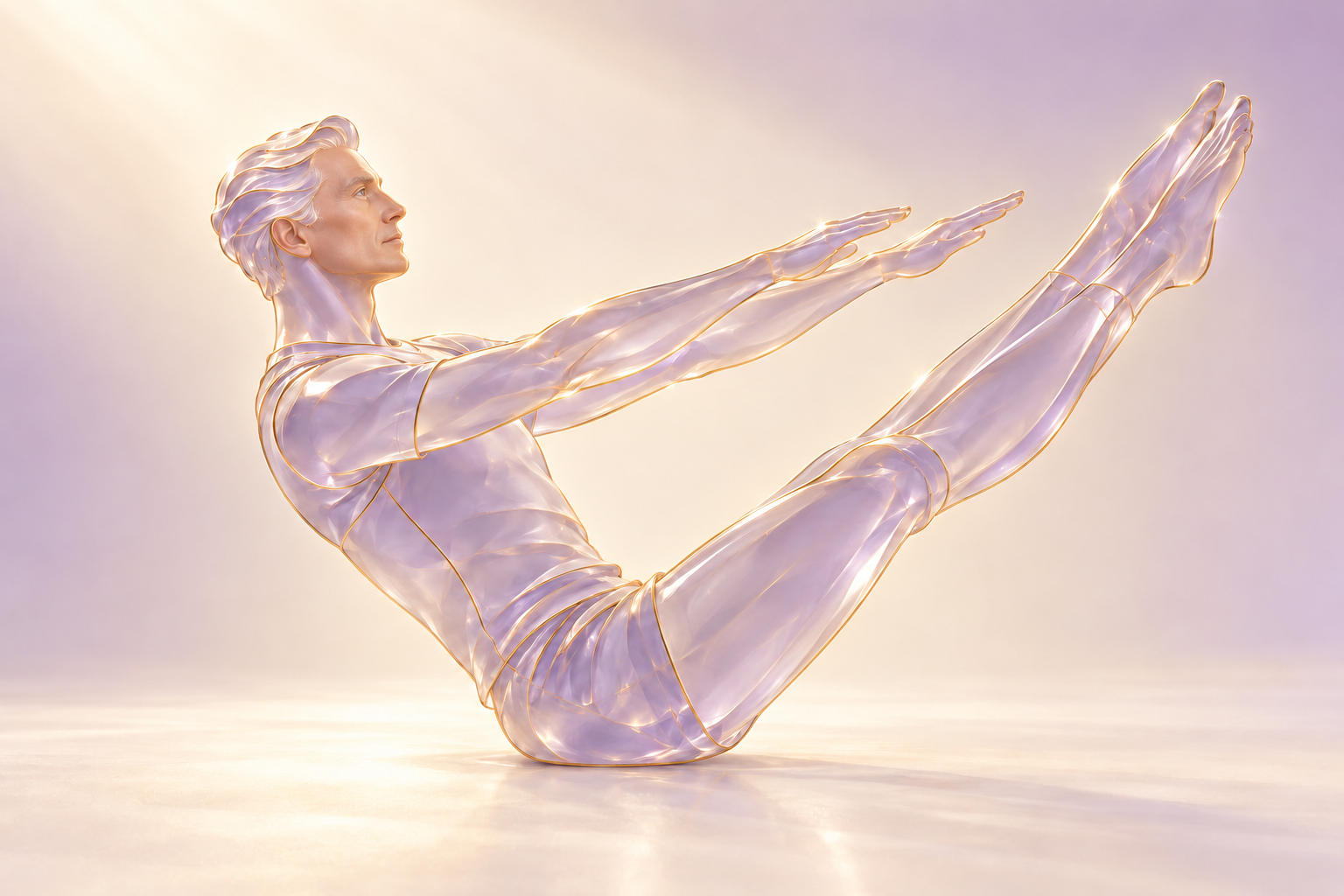
This distinction matters: 34 is the number of mat exercises published in the 1945 book, not the total number of Pilates exercises. The sequence includes familiar names such as the Hundred, Roll Up, Teaser and Swimming, and ends with the Push Up. The original exercise sequence.
Alongside the mat repertoire came extensive apparatus work: the Reformer, Cadillac or Trapeze Table, chairs, barrels and smaller devices. Pilates Method Alliance’s equipment history.
Professional literature sometimes describes a repertoire of more than 500 exercises. This conveys the scale of the system rather than a single, fixed count across every teaching tradition and variation. The answer to “How many exercises are there?” therefore has two parts: 34 in the original mat book; hundreds across the wider method. Muscolino and Cipriani on the structure of the method.
What Did He Want Us to Learn?
Near the beginning of Return to Life, Pilates wrote: “Physical fitness is the first requisite of happiness.” This expresses an ambitious philosophy, not a medical guarantee. He wanted a body capable of meeting everyday demands, accompanied by an alert, engaged mind. Breathing, concentration, controlled movement and consistent practice were central to that approach. Return to Life Through Contrology.
There is another revealing detail. The familiar six principles—concentration, control, centring, precision, breathing and flow—were formulated later. Philip Friedman and Gail Eisen helped codify them in their 1980 book. They are useful teaching ideas, but the numbered list should not be attributed to Joseph Pilates himself. Rouhiainen’s historical discussion.
The Dancers Who Carried It Forward
Dance became an important route through which his work spread. Ruth St. Denis told Ted Shawn about training with Pilates; Shawn tried it himself and later invited him to teach at Jacob’s Pillow. The institution’s history records an invitation in 1941 and teaching in subsequent years. Dancers encountered his method beyond the Manhattan studio. Pilates at Jacob’s Pillow.
Students became teachers. Romana Kryzanowska, Carola Trier, Eve Gentry, Ron Fletcher, Kathleen Stanford Grant and Lolita San Miguel are among the central figures often described as the first generation. They passed on exercises, teaching approaches and experience gained with Joseph and Clara. Continuity also brought different interpretations, helping explain the diversity of Pilates today. Pilates Method Alliance.
The Man Died. The Work Continued.
Pilates died in New York on October 9, 1967, aged 83. Clara continued the studio’s work, and Romana became central to its future. He did not live to see the worldwide success that arrived decades later. Haus der Geschichte / LeMO.
In 2000, a US federal court ruled, in a trademark dispute, that Pilates was a generic term for the exercise method in the contexts at issue. His name had become part of professional and public language, extending beyond a single business. The court’s decision.
Perhaps the most compelling part of this legacy is how patiently it was built. Years of teaching, adjusting, making and experimenting. People who came to the studio and kept returning. Students who became teachers, and teachers who passed their knowledge on.
As we step onto a mat or place our feet on a Reformer, we can remember that journey. Behind each exercise is a history. Within the practice is a personal opportunity: to notice how we move, learn something about our bodies and take that understanding into the day beyond the studio.